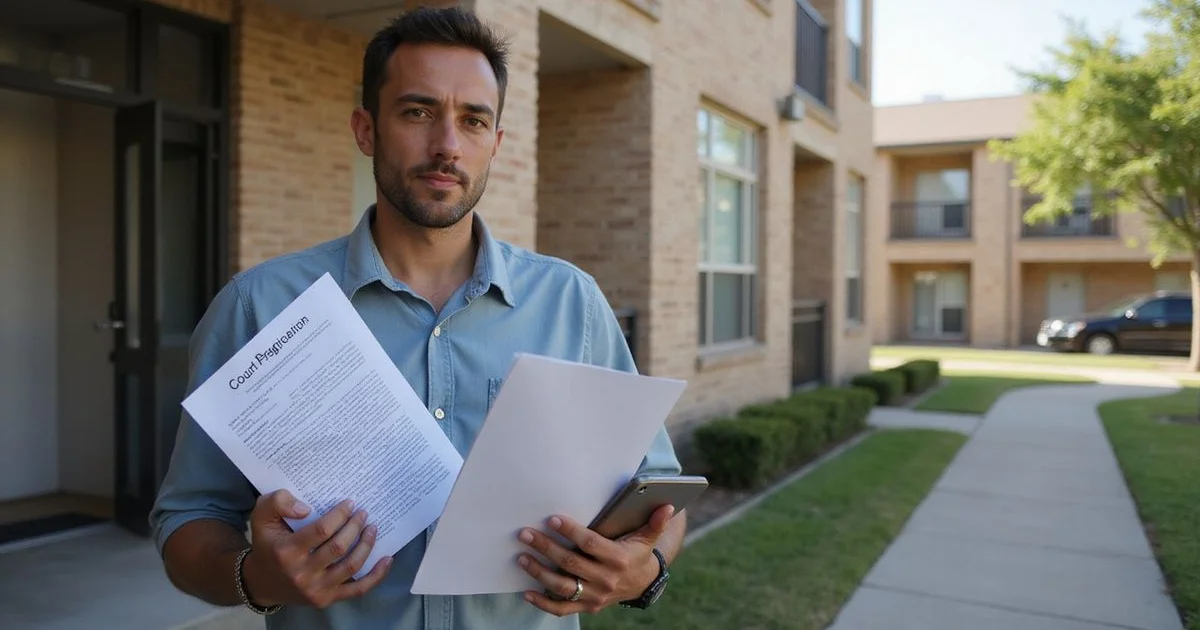
We frequently assist local homeowners and business owners transitioning into the Fort Worth rental market. Finding apartments that accept evictions in Fort Worth presents a unique challenge for anyone relocating after a property loss.
A recent market analysis shows that Tarrant County courts processed around 47,000 eviction filings over the past year.
That massive volume tells us one thing. Leasing offices see these records on a daily basis.
Our team knows exactly how screening software evaluates these complex applications. The difference between an approval and a rejection often comes down to paperwork.
Let’s review the actual court data and explore practical ways to present your application.
Start by finding out what you actually have
The phrase “I have an eviction” covers four different records on a court file. This distinction decides whether half of Fort Worth can approve you or almost none of it can.
On a Tarrant County JP court record, you might find one of these statuses:
- A filing. A case was opened against you.
- A dismissal. The case closed without a judgment against you. The landlord dropped it, you paid the balance, or the parties settled.
- A judgment. The court ruled in favor of the landlord.
- A writ of possession. The court enforced the judgment and required a move-out.
We see many leasing companies draw their strict criteria line right between a judgment and a dismissal. Many renters carrying a dismissed filing face rejections at properties where the written policy would actually approve them. This happens simply because nobody informed the applicant about the specific record type on file.
Tenant screening platforms like RealPage and Yardi automatically flag these court entries. You must pull your file from the Tarrant County Records Search website before you apply anywhere else. This public portal clearly displays the crucial disposition line.
Age matters, and so does the balance
Two records that look identical on paper receive very different reactions from a leasing manager depending on the timeline and the money involved.
- When the event happened. A judgment from 2019 reads much differently than a filing from last month. Many apartment communities apply a strict age cutoff, commonly ranging between two and five years. An older record eventually moves from an automatic disqualification to a flexible conversation. The Fair Credit Reporting Act (FCRA) allows these judgments to remain on your credit profile for up to seven years, making exact dates critical.
- How much you owe. A judgment with a zero balance presents a much stronger application than an open file showing $3,400 still due. If you have settled the debt, you must secure a formal payoff letter. This single page does more heavy lifting at a leasing desk than any other document you can provide.
Our experts closely monitor legislative shifts like Texas Senate Bill 38. This new law took effect on January 1, 2026, and significantly tightened eviction timelines across the state.
The mandate pushes some case resolutions to just 21 days.
This accelerated process does not change how an older record reads. It just means new filings escalate much faster. You need to act immediately if your case is recent and still active.
Which paths stay open
An eviction record automatically routes you to the money-owed path. You will typically encounter four specific fee structures in this scenario.
| Structure | Cash at signing | Total over a 12-month lease | Refundable? |
|---|---|---|---|
| Doubled deposit | $1,000 on a $500 quoted deposit | $1,000 | Yes |
| Last month up front | $1,956 at $1,456 rent | $1,956 | Applied to rent |
| Deposit alternative | Low initial premium only | Roughly $2,500 | No |
| Guarantor overlay | Varies by provider | Often near $1,100 | No |
We updated these illustrative figures using the Fort Worth average rent of $1,456 based on July 2026 data from RentCafe. Your actual premiums and fees will vary significantly based on the specific property and the third-party product they use.
Many modern properties use deposit alternative platforms like Jetty or Rhino instead of requiring massive cash deposits. You should note the large cost spread across these options. A renter might see a $1,500 difference between the cheapest structure and the most expensive one over a single lease term.
Calling the property to verify which structure they accept is the smartest move before you spend money on an application fee.

Where in Fort Worth this works
Property acceptance is always a management company decision rather than a neighborhood rule. We prefer to state that fact directly to save you time.
Older housing stock across East Fort Worth, Meadowbrook, Woodhaven, Poly, and Como typically features local, independent management. These leasing managers are far more likely to read a payoff letter and review your letter of explanation personally.
How Automated Screening Zones Operate
Newer institutional products in North Fort Worth and the Alliance corridor operate quite differently. Massive management firms like Greystar or Lincoln Property Company rely heavily on automated screening software. This digital process is incredibly fast but offers almost zero flexibility for flagged files.
The one major exception involves brand-new communities currently in lease-up. Strong pressure to fill empty units makes a leasing office much more willing to work with a flagged file if you attach a deposit structure.
Our team recognizes this as a posture shift rather than a permanent criteria change. It provides no absolute guarantee. This temporary urgency simply explains why the newest buildings in Tarrant County sometimes serve as the most eviction friendly apartments in Fort Worth.
What we can’t do
Guarantee you’ll be approved. Criteria vary, change without notice, and are applied by screening software the leasing office doesn’t always override. Anyone advertising guaranteed approval for renters with evictions is telling you something that isn’t true.
What to do this week
We recommend a specific, actionable plan to get ahead of the screening process. Start by gathering your documentation and knowing your exact numbers.
- Pull the Tarrant County record. Visit the official Tarrant County Records Search portal online. Find the exact disposition status to see if it reads dismissed, judgment, or still open.
- Get a payoff letter if you have satisfied a balance. Request this document from the specific collection agency handling the debt, such as Fair Collections & Outsourcing. If you have not paid the debt, secure the current payoff figure so you know the exact financial requirement.
- Write two paragraphs of explanation. Detail what happened, when it occurred, and what has changed since then. Keep the tone factual and dated while avoiding any defensiveness.
- Work out your income multiple. Divide your gross monthly income by your target rent. An income multiple under 2.5 requires its own strategic approach alongside this eviction plan.
- Send us the property you are considering. We will call the leasing office to find out exactly what they do with your specific record type and which deposit structures they accept.
Carrying a balance from a broken lease instead of a court filing creates a slightly different situation with identical fixes. You can read exactly how screening reports read your file to understand what the property manager sees on their end.
Contact our team today if you need help presenting your application to a leasing office.